Enitan Bello is a Nigerian artist based in Toronto whose work spans a range of mediums including writing, painting, drawing, sculpting, photography, dance, sound, and more. She sees art as one of the greatest forms of self-expression and is deeply influenced by British-Nigerian artist Yinka Shonibare, who once said, “For me, it’s never really about form; specifically, form is just a vehicle, it’s a means of saying what you need to say.” Enitan creates art to communicate with the world.
She focuses on whatever she’s passionate about at the time and sees her work as a tangible diary, an extension of herself in that moment. She is passionate about doing justice to her ideas by staying open to new mediums and techniques to best express her message. She creates with one of his quotes in mind, “I want to marry the content with the form.” Her work touches on realities she witnessed growing up in Nigeria, social issues such as racism, sexism, and misogyny but also themes like joy, community, faith, and Love.
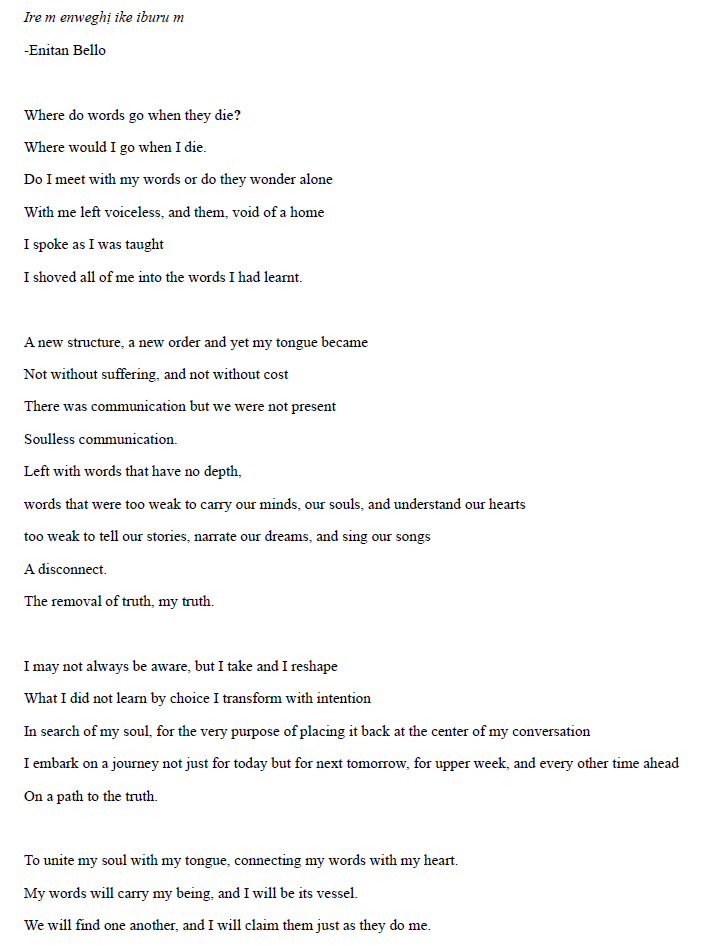
“Ire m enweghị ike iburu m” (My tongue cannot carry me.)
Poem, 240 words, 2026
“Ire m enweghị ike iburu m” is about the things that are forgotten and the power of the words we wield. This poem speaks to what it means, for me, to own the words I speak.
As someone who was born and raised in Nigeria, much of life has been, and continues to be, intertwined with the British. I was never taught any of my country’s languages growing up, and I still struggle to learn them. My poem centers on the act of true communication, the transformation of communication, and the empowerment that comes with reconnecting to it.
Colonized by the British, Nigeria was stripped of its cultural languages and structures. Now, with English as a national language, I find that the medium of communication many of us are left with is rather soulless; it has no home, and its host has no true voice. This poem highlights how the ways we tell our stories, narrate our dreams, sing our songs, express ourselves, and speak our minds have been, and continue to be, dictated by the British.
It delves into the transformation of British English in Nigeria into Nigerian English, with the introduction of phrases and words that carry our soul and our being: twists on language such as “next tomorrow,” meaning the day after tomorrow, or “upper week,” meaning the week after next. These small and often overlooked acts become the beginning of a revolution.
This poem traces a once-lost soul back to the voice that it cries for, maybe not in the way it was originally intended, but in a way that tells its history and resilience.